
The New Markets Tax Credit (NMTC) is a 39 percent federal tax credit for investors that put money into a certified Community Development Entity (CDE), which lends it on favorable terms to businesses and projects in low-income areas. The credit became permanent in July 2025, and in September 2026 the Treasury Department's Community Development Financial Institutions Fund (CDFI Fund) opened the first permanent round, worth $5 billion.1,6
Key Takeaways
| 01 | The NMTC is a 39 percent federal tax credit claimed over seven years. Investors claim 5 percent in each of the first three years and 6 percent in each of the last four. |
| 02 | Businesses reach the credit through a CDE. In each round, the CDFI Fund awards a fixed amount of credits to CDEs, which then choose the projects they finance. |
| 03 | A typical deal leaves the project with a subsidy of about 20 to 25 percent. It arrives as a below-market "B loan" that is effectively forgiven after year seven. |
| 04 | The credit is now permanent at $5 billion a year. Allocation the CDFI Fund does not award in a year can carry forward for up to five years. |
| 05 | Applications for the 2026 round are due November 10, under new conditions. Registration closes October 6, and winners' contracts add new anti-discrimination rules and limits on how the money can be used. |
On September 15, 2026, the CDFI Fund published the Notice of Allocation Availability (NOAA) for the calendar year (CY) 2026 round, making $5 billion in allocation available, with applications due November 10, 2026.5 That $5 billion is the amount of investment that can earn the credit, which works out to about $1.95 billion in tax credits.20 It is the first round under a permanent statute. The reconciliation law signed July 4, 2025 (Public Law 119-21) removed the credit's expiration date and ended two decades of short-term extensions.1,3
For manufacturers, health systems, developers, and community organizations, the NMTC can fill the gap when a project cannot get enough conventional financing. It is also complex. This article explains what the credit is, what it can finance, how a deal works, and what to expect from the 2026 round.
What Is the New Markets Tax Credit?
Congress created the NMTC in December 2000 to draw private capital into communities that conventional lenders overlooked.1 The credit goes to an investor that makes a qualified equity investment (QEI), meaning a cash purchase of stock or a partnership interest, in a CDE. A CDE is a corporation or partnership certified by the CDFI Fund whose mission is serving low-income communities and whose governing or advisory board includes residents of those communities. Banks, community development financial institutions, nonprofit lenders, and for-profit finance companies all run CDEs. Certification alone carries no credits. A CDE must also win an "allocation," the right to offer a set amount of credits to investors, in a competitive round.1
Since the program began, the CDFI Fund has run 21 rounds and handed out about $91 billion in allocation.6 Through fiscal year (FY) 2023, CDEs had invested $71 billion in 8,439 businesses and projects, supporting more than 888,000 full-time-equivalent jobs. Three-quarters of those dollars went to tracts meeting at least one "severe distress" test, such as a poverty rate of 30 percent or more.12
What Can It Finance?
Once investors put money into a CDE, the CDE has 12 months to invest at least 85 percent of it in qualifying businesses and projects, and it must keep that money invested for the full seven years.2 These investments are called qualified low-income community investments (QLICIs), and most are loans. The business that receives one is legally a qualified active low-income community business (QALICB).1 Exhibit 1 sets out the tests a business must meet.
Exhibit 1
A business qualifies based on where it is located and where it does its work
Who can receive NMTC financing, location and business tests
| Test | What it requires |
|---|---|
| Location | The project must be in a low-income census tract: one where at least 20 percent of residents live in poverty, or where median family income is no more than 80 percent of the area median |
| Where it earns its money | At least half of the business's gross income must come from its work in low-income areas |
| Where the work happens | At least 40 percent of its property (owned or leased) must be used, and 40 percent of its employees' work done, in low-income areas |
| Businesses that cannot qualify | Apartment buildings and other residential rentals, golf courses, country clubs, massage parlors, hot tub and tanning facilities, racetracks and other gambling facilities, liquor stores, and farms with more than $500,000 in assets |
Sources: 26 U.S.C. §§ 45D, 1397C, 144(c)(6)(B), 26 C.F.R. § 1.45D-1.
The program tends to fund large, expensive projects that banks are reluctant to finance on their own: manufacturing plants, community health centers, charter schools, grocery stores, mixed-use redevelopments, and nonprofit facilities. More than 90 percent of investments through FY 2023 carried below-market interest rates.12 Most deals also combine NMTC money with other public help. The Government Accountability Office (GAO) found that 62 percent of NMTC projects from 2010 to 2012 also received other federal, state, or local assistance.16
Housing is limited. Apartment buildings do not qualify on their own, so housing usually comes in through mixed-use buildings, where apartments bring in less than 80 percent of the rent, or through homes built for sale.1,19 This year's application puts new weight on for-sale homes. It lists building or rehabilitating homeownership units as an "Innovative Investment" option, and it adds high housing costs to the ways an applicant can show an area is distressed.6
How Does an NMTC Deal Work?
The credit is claimed on seven "credit allowance dates": the day the QEI is made and each of the next six anniversaries. Because investors wait up to seven years to collect it all, they pay less than a dollar for each dollar of credit.1 Exhibit 2 shows the seven installments.
Exhibit 2
The 39 percent credit is claimed in seven installments, with the larger payments in years four through seven
NMTC credit allowance schedule, percent of qualified equity investment
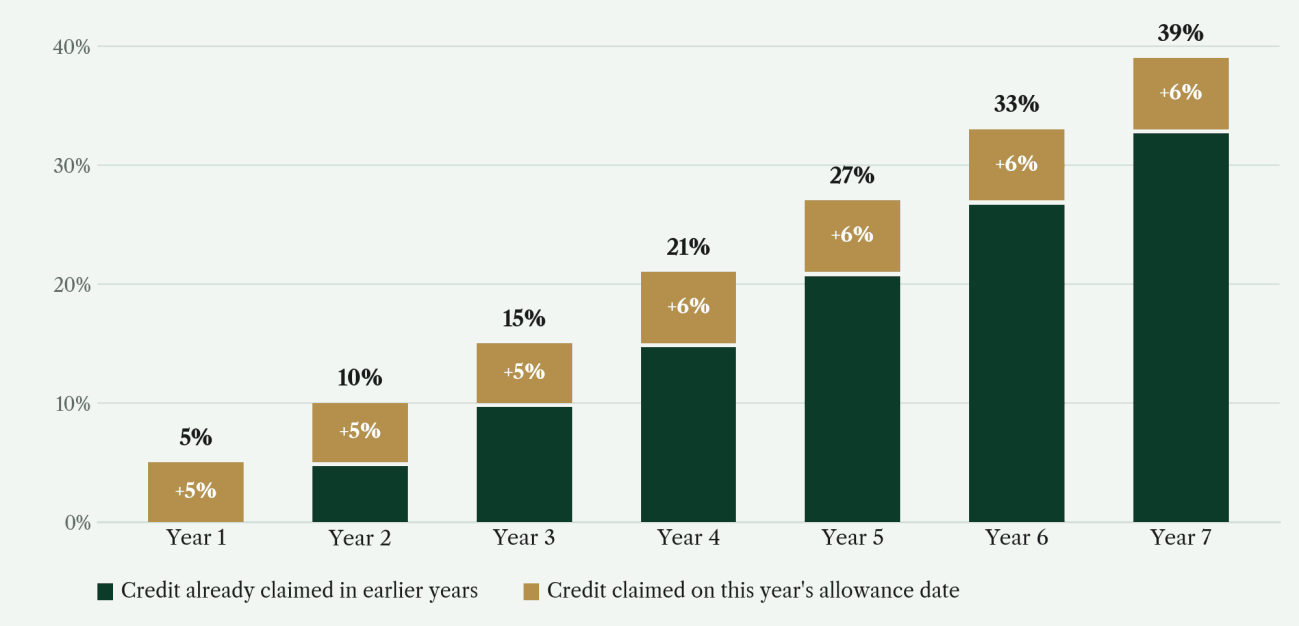
Source: 26 U.S.C. § 45D(a). On a $10 million QEI, the annual credit is $500,000 in each of years one through three and $600,000 in each of years four through seven, for a total of $3.9 million.
Almost every deal is "leveraged." The investor forms an investment fund that combines its own cash with a larger "leverage loan," often from the project's own bank or a related party, and the fund makes the investment in the CDE (the QEI). The Internal Revenue Service (IRS) confirmed in Revenue Ruling 2003-20 that borrowed money counts toward the QEI. As a result, the investor earns credits on the full QEI while contributing only a fraction of it.13,14
The CDE keeps its fees and reserves and lends the rest to the project as two loans. The A loan matches the leverage loan. The B loan is roughly the investor's equity, minus the CDE's fees, at a below-market rate. After year seven, once the investor has claimed all its credits, the project or an affiliate typically buys the investor's stake in the fund for a token amount under a prearranged "put/call" agreement. Because the project side now owns the fund that holds the B loan, that loan is effectively canceled. The project keeps the money, and that is the subsidy.13,15 Exhibit 3 follows the dollars through a $10 million deal.
Exhibit 3
A leveraged deal turns $2.8 million of investor equity into $3.9 million of credits and a $2.4 million subsidy for the project
Illustrative leveraged structure, $10 million qualified equity investment
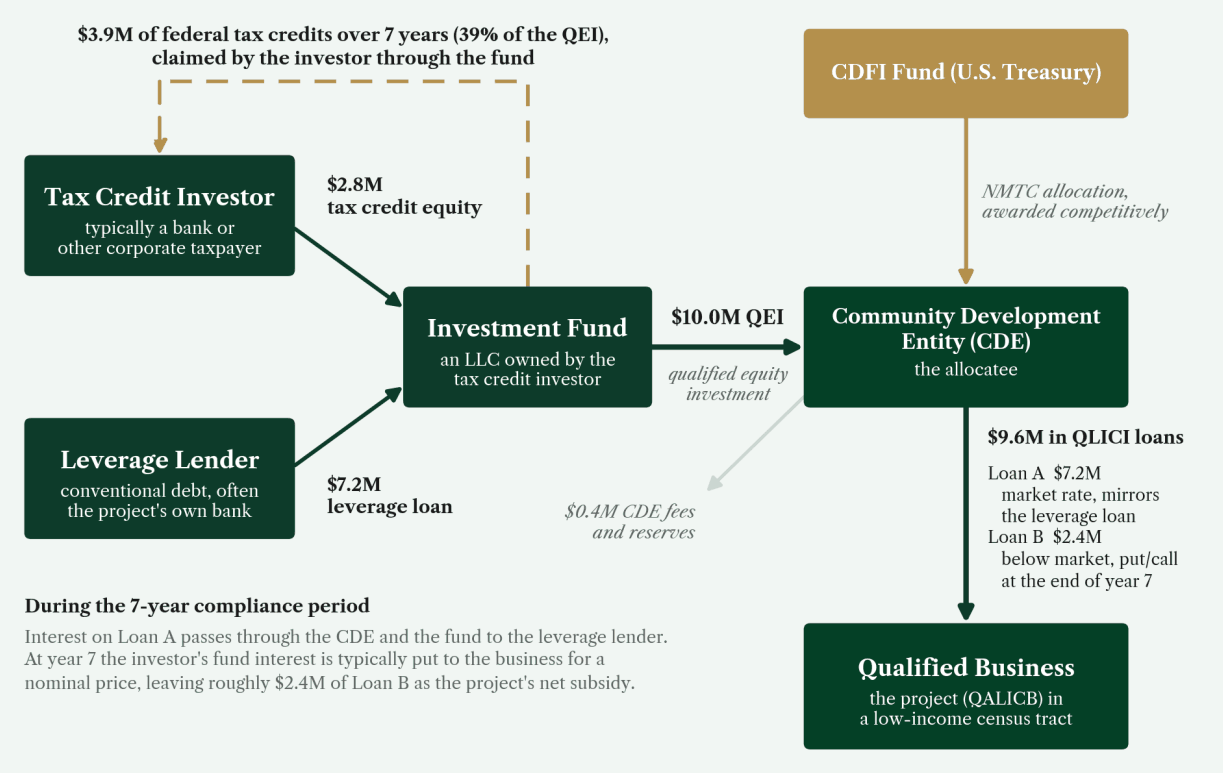
Sources: Office of the Comptroller of the Currency (OCC), Community Developments Insights (June 2013), IRS Rev. Rul. 2003-20, GAO-10-334. Figures are illustrative. Credit pricing, fees, and loan terms vary by transaction.
Pricing and fees decide how much reaches the project. The example assumes the investor pays about 72 cents per credit dollar, in line with what regulators have reported.13,15 Recent market commentary puts pricing closer to 79 cents.22 On a $10 million deal, every one-cent change in price moves the subsidy by about $39,000, and higher fees shrink it. Banks are the main buyers in part because NMTC investments help them meet the Community Reinvestment Act, a federal law under which regulators rate banks on how well they serve low- and moderate-income areas.13,17
The credit can be taken back for seven years. If the CDE loses its certification, stops meeting the 85 percent investment rule and does not fix it within six months, or pays the investor back early, the investor must repay every credit claimed, with interest.1,2,18 That risk is why NMTC deals carry extensive covenants and reserves, and why a sponsor is signing up for a seven-year compliance relationship.
What Changed in 2025?
- The credit is permanent. Section 70423 of P.L. 119-21 set the $5 billion annual allocation for "each calendar year after 2019," effective for years beginning after December 31, 2025.1,3 The Joint Committee on Taxation estimated the change will cost about $5.2 billion over fiscal years 2025 through 2034, a figure that builds slowly because credits are claimed over seven years.4
- Unused allocation now expires after five years. Allocation not awarded in a given year can carry forward up to five years. Leftover allocation from before 2026 is treated as arising in 2025, so it must be awarded by 2030.1,3
- The credit itself is unchanged. It is still 39 percent over seven years. The final law did not index the $5 billion to inflation or let investors use the credit against the alternative minimum tax.20
Exhibit 4 shows annual allocation authority since 2001.
Exhibit 4
After 25 years of short-term extensions, the $5 billion a year no longer expires
Annual NMTC allocation authority, 2001-2027, $ billions
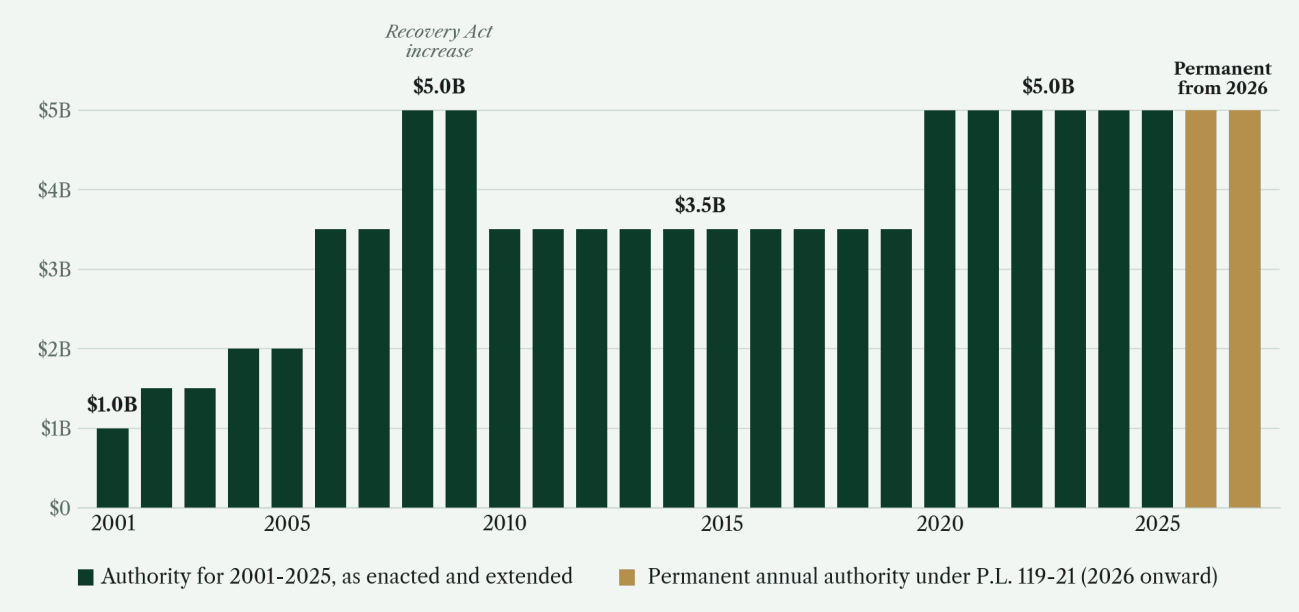
Sources: 26 U.S.C. § 45D(f)(1), as amended by P.L. 119-21, § 70423. Statutory limitation by calendar year. Excludes $1 billion of special Gulf Opportunity Zone authority made available for 2005 through 2007, and actual CDFI Fund award amounts, which vary slightly by round.
What Does the CY 2026 Round Look Like?
The first permanent round is a single-year, $5 billion round. The NOAA anticipates awards of up to $100 million per winner, though the CDFI Fund can award more or less. The CDFI Fund expects to announce awards in summer 2027.21 Applicants must be certified CDEs or have applied for certification by September 22, 2026, and nonprofit applicants must control a for-profit subsidiary CDE that will receive the allocation.5 Exhibit 5 lists the key dates for the 2026 round.
Exhibit 5
CDEs have eight weeks from notice to deadline
CY 2026 NMTC allocation round key dates, Eastern Time, as of September 22, 2026
| Date | Milestone |
|---|---|
| Sept. 15, 2026 | NOAA published in the Federal Register (91 FR 58526) |
| Sept. 17, 2026 | Round opens and application materials are released |
| Sept. 22, 2026 | CDE certification applications due for applicants not yet certified |
| Sept. 29, 2026 | Questions due for the CDFI Fund's recorded question-and-answer webinar |
| Oct. 6, 2026, 5:00 p.m. | Application registration closes. Applicants that miss it cannot submit. |
| Nov. 6, 2026, 5:00 p.m. | Last day to contact the CDFI Fund with questions |
| Nov. 10, 2026, 5:00 p.m. | Allocation applications due |
| Jan. 7, 2027 | CDEs with earlier awards must show they have put a required share of them to work |
Sources: CDFI Fund, CY 2026 Notice of Allocation Availability (Sept. 15, 2026), CDFI Fund news release (Sept. 17, 2026).
Scoring rewards strategy, outcomes, and a track record. Applications are scored mainly on Business Strategy and Community Outcomes, up to 25 points each. Up to 10 bonus points are set by law: five for a record of serving disadvantaged businesses or communities, and five for investing in businesses the CDE is not affiliated with.5 Past winners must also prove they are using earlier awards. By January 7, 2027, they must have raised investor money against all of their CY 2020 award, a share that steps down to 10 percent of their CY 2024-2025 award.5
Treasury's December 2025 reforms are now written into the round. When it announced the $10 billion CY 2024-2025 awards, Treasury named four priorities for future rounds: affordable housing, small business growth, domestic manufacturing and job-producing projects, and rural hospitals and community health infrastructure.7 The NOAA writes the reforms Treasury announced alongside them into the contracts winners sign. Winners may not invest in a business "that violates applicable Federal anti-discrimination laws, including a QALICB providing employment or financial preferences or set-asides based on any person's race, ethnicity, or sex." NMTC money can pay off a project's existing debts only for costs incurred in the prior 24 months or up to 5 percent of the financing. And the CDFI Fund commits to placing 20 percent of investments in rural (non-metropolitan) counties.5
"With the NMTC program now permanent, it is imperative that these federal incentives are focused on lasting job creation rather than the latest political trends."
Scott Bessent, U.S. Secretary of the Treasury
Source: U.S. Department of the Treasury, December 23, 2025. Photo: official portrait, U.S. Department of the Treasury.
Recent rounds were oversubscribed. The CY 2024-2025 double round drew 216 applications requesting $19.2 billion against $10 billion available, and 142 CDEs won awards.8,9 The CY 2023 round drew 196 applications requesting $14.7 billion against $5 billion.10,11 Exhibit 6 compares requests with available allocation.
Exhibit 6
Demand for allocation has run two to three times the authority available
NMTC allocation requested versus available, $ billions
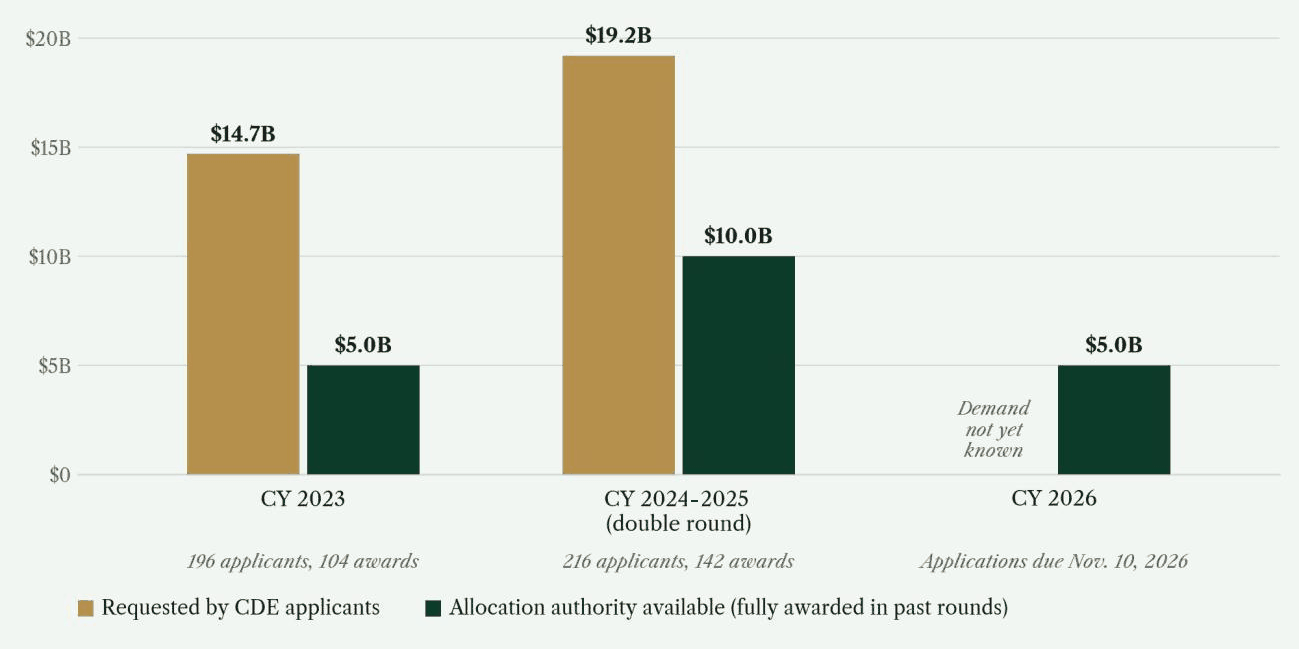
Sources: CDFI Fund, CY 2024-2025 NMTC Award Book (Dec. 2025), CDFI Fund news releases (Mar. 14, 2025, and Sept. 19, 2024), CY 2026 Notice of Allocation Availability.
What to Do Now
This round matters most to two groups: CDEs preparing applications, and sponsors of projects in low-income census tracts that cannot close on conventional financing alone. Awards from this round are expected in summer 2027, so until then much of the NMTC money available to projects will come from CDEs that won in the CY 2024-2025 round. If you want a read on fit before the November 10 deadline, reach out to our team.
References
- 26 U.S.C. § 45D, New markets tax credit, including amendment notes for Pub. L. 106-554, § 121 (Dec. 21, 2000) and Pub. L. 119-21, § 70423 (July 4, 2025).
- 26 C.F.R. § 1.45D-1, New markets tax credit.
- Internal Revenue Service, "New markets credit updated and made permanent."
- Joint Committee on Taxation, JCX-35-25 (July 1, 2025), "Permanent extension of New Markets Tax Credit."
- CDFI Fund, "Notice of Allocation Availability Inviting Applications for the Calendar Year 2026 Allocation Round of the New Markets Tax Credit Program," 91 Fed. Reg. 58526 (Sept. 15, 2026).
- CDFI Fund, "CDFI Fund Opens CY 2026 Round of New Markets Tax Credit Program" (Sept. 17, 2026).
- U.S. Department of the Treasury, "Treasury Pairs New Markets Tax Credit Awards with Program Reforms" (Dec. 23, 2025).
- CDFI Fund, The New Markets Tax Credit Program Award Book, Calendar Year 2024-2025 (Dec. 2025).
- CDFI Fund, "CDFI Fund Releases Application Demand for CY 2024-2025 Round of the New Markets Tax Credit Program" (Mar. 14, 2025).
- CDFI Fund, "CDFI Fund Releases Application Demand for CY 2023 Round of the NMTC Program."
- CDFI Fund, "The U.S. Department of the Treasury Announces $5 Billion in New Markets Tax Credits" (Sept. 19, 2024).
- CDFI Fund, New Markets Tax Credit Public Data Release, FY 2003 to FY 2023 Summary Report (Aug. 2026).
- Office of the Comptroller of the Currency, "New Markets Tax Credits: Unlocking Investment Potential," Community Developments Insights (June 2013).
- Internal Revenue Service, Revenue Ruling 2003-20.
- U.S. Government Accountability Office, GAO-10-334 (Jan. 2010).
- U.S. Government Accountability Office, GAO-14-500 (July 2014).
- Urban Institute, New Markets Tax Credit (NMTC) Program Evaluation: Final Report, prepared for the CDFI Fund (2013).
- Internal Revenue Service, New Markets Tax Credit Audit Technique Guide (May 2010).
- 26 U.S.C. § 1397C, Enterprise zone business defined.
- Frost Brown Todd, "One Big Beautiful Bill Act Delivers Historic Win, Making New Market Tax Credits Permanent" (2025).
- CDFI Fund, New Markets Tax Credit Program (program overview and CY 2026 timeline).
- Area Development, "New Markets Tax Credits Are Now a Permanent Part of the Deal Stack," Q3 2026.
© Copyright 2026 TC Policy Group, LLC (d/b/a Crawford Partners). The views expressed herein are those of the author(s) and not necessarily the views of Crawford Partners, its management, its subsidiaries, its affiliates, or its other professionals. Crawford Partners is not a law firm and cannot provide legal advice.